Parental Social and Musical Characteristics, the Home Music Environment, and Child Language Development in Infancy
Ashley Boyne, Camila Alviar, and Miriam Lense
January 21, 2026
https://onlinelibrary.wiley.com/doi/full/10.1111/infa.70008
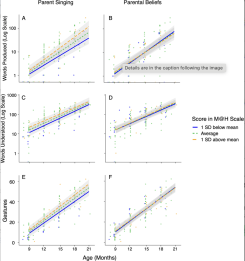
ABSTRACT Parents use music, especially singing, to interact with their young children, supporting parent-child bonding and social communication. Little is known about the parental attributes that support musical interactions with their infants. In this exploratory study, we analyzed self-report data from 43 caregiver/infant dyads at up to four time points (9, 12, 15, and 18 months) to assess parent social motivation and musical training as predictors of the home music environment overall, parental singing, and parental beliefs in the benefits of music.
Integrated Parent-Child Music Classes for Preschoolers with and without ASD: Parent Expectations and Experiences
Lense M, Liu T, Booke L, Crawley Z, Beck S
July 26, 2022
https://nyaspubs.onlinelibrary.wiley.com/doi/full/10.1111/nyas.14875?casa_token=ue8qlmlWOz0AAAAA%3A717M55qUiY_6B8uB2dYew5F8TWPk0hqkfVVBL7U6hF7DOBfMOCKtmcv0CJcCJ67FoAIA7fzcgaPUwHlY
Integrated recreational programs designed to support neurodiverse children and their families are important vehicles for community participation. In this mixed-methods study, we investigated the mechanisms by which parent-child music classes for autistic and neurotypical children can support community participation. Parents of autistic (n=33) and typically developing (TD; n=28) preschoolers were interviewed about their expectations for and experiences of participating in a 12-week psychoeducational parent-child music program.